Why Your Resume Is Not Getting Interviews: 10 Reasons
Applying for jobs but getting no interviews? Learn 10 possible resume and job-search issues, see practical before-and-after examples, and use a clear process to improve your next application.
11 min read · November 7, 2026
You apply for 30 jobs. You meet many of the stated requirements. Yet your inbox contains automated acknowledgments, rejection emails, or nothing at all. It is understandable to wonder whether you are unqualified or whether your resume is failing.
Neither conclusion is automatic. A lack of interviews can reflect how your experience is presented, how closely an application matches the role, the strength of the applicant pool, an internal candidate, a hiring pause, or a job description that changed after posting. But if you are repeatedly sending the same resume and seeing little response, it is worth examining what employers may be seeing—or missing.
A strong resume is not a complete record of everything you have done. It is a focused argument for your fit for a specific type of role. It should help a recruiter quickly identify your direction, relevant evidence, and likely contribution. Here are 10 reasons that argument may not be coming through.
1. You are sending a generic resume
One resume rarely fits every vacancy, even when job titles look similar. One software engineering role may emphasize backend services, while another focuses on mobile development. An administrative role may prioritize calendar management in one organization and reporting, procurement, or event support in another.
Customizing does not mean rewriting your work history or copying a job description. It means changing emphasis. Lead with the experience, skills, projects, and outcomes most relevant to the work in front of you. When every past responsibility receives equal weight, the recruiter has to do the matching work.
There is survey evidence supporting the value of customization, with an important limitation. In a 2017 US CareerBuilder survey of 2,575 hiring and HR managers, 60% said resume customization was a factor that made them more likely to pay attention to an application. That finding does not establish a specific increase in interview chances, and employer practices have changed since then. It does reinforce a practical point: relevance is easier to recognize when you make it visible.
2. Your professional positioning is unclear
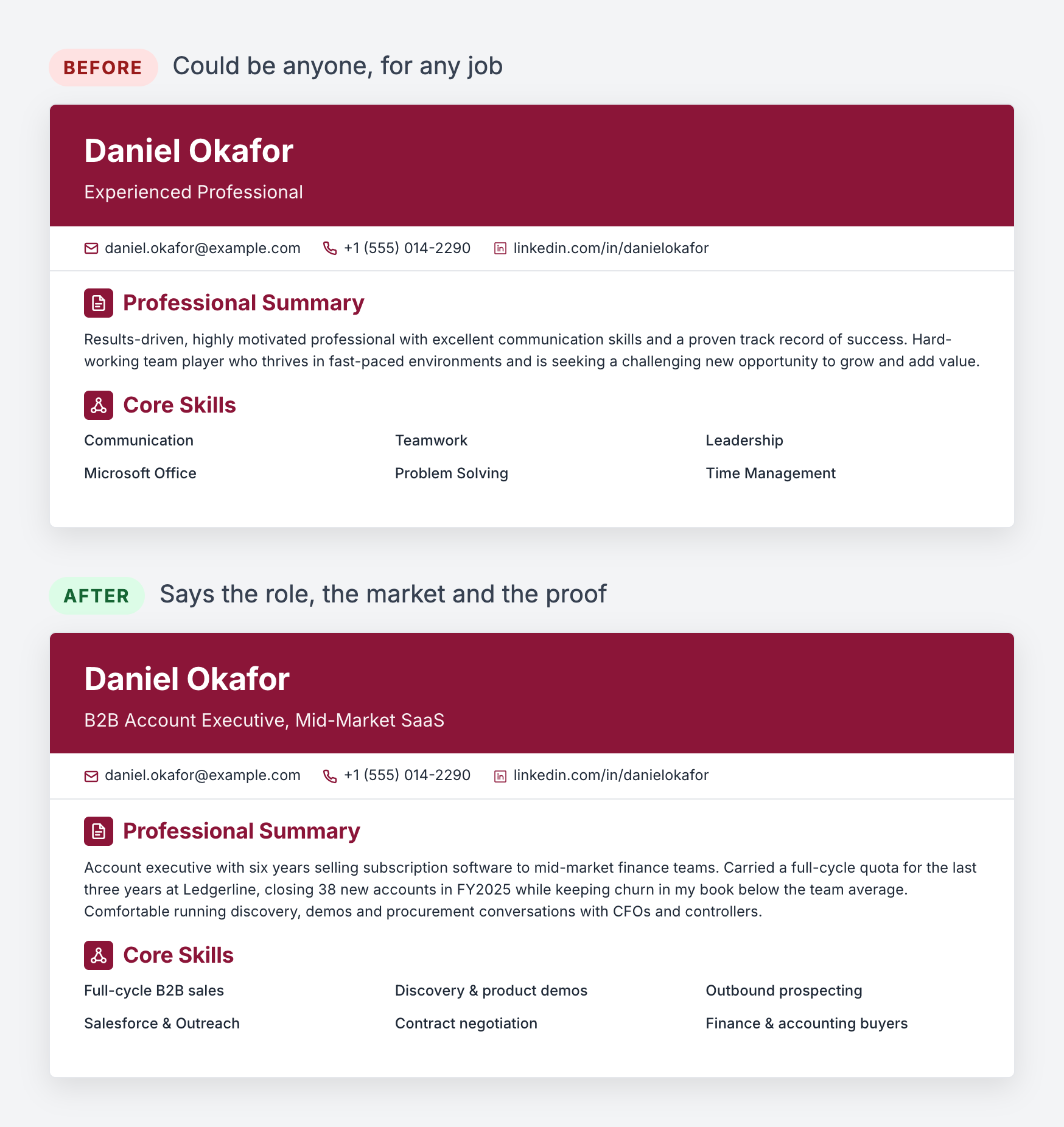
A reader should be able to answer a basic question within seconds: What kind of professional is this person, and what roles are they pursuing? A headline that says only “Professional,” or a summary that blends several unrelated directions, can make your target difficult to identify.
This is common for career changers, recent graduates, and candidates with broad experience. You do not need to hide your background. You do need to frame it. A clear headline, a short targeted summary when useful, and carefully selected experience can show how your past work supports your next role.
For example, “Operations Coordinator | Scheduling, vendor communication, and records management” is more informative than “Experienced professional seeking new opportunities.” The first version gives the reader a role direction and evidence to look for.
3. You list responsibilities but not achievements
Responsibilities explain your scope. Achievements show your contribution. “Managed customer accounts” tells a recruiter what your role included, but not what you improved, solved, delivered, or influenced.
You do not need dramatic metrics to demonstrate value. Credible evidence can include a process you streamlined, a recurring problem you resolved, a system you maintained, a deliverable you completed, positive feedback you earned, or the scale and complexity of the work you handled. Use numbers when you can verify them. Do not invent percentages, revenue figures, or productivity gains simply to make a bullet sound stronger.
CareerBuilder’s 2018 survey, conducted by The Harris Poll among 1,138 US hiring and HR managers, found that 34% identified a lack of quantifiable results as an immediate resume deal-breaker. This does not mean every bullet needs a metric, or that 34% of resumes are rejected for that reason. It does suggest that employers may want clearer evidence of contribution. Context, scope, and specific work can strengthen a bullet when a reliable number is unavailable.
4. You are missing relevant keywords
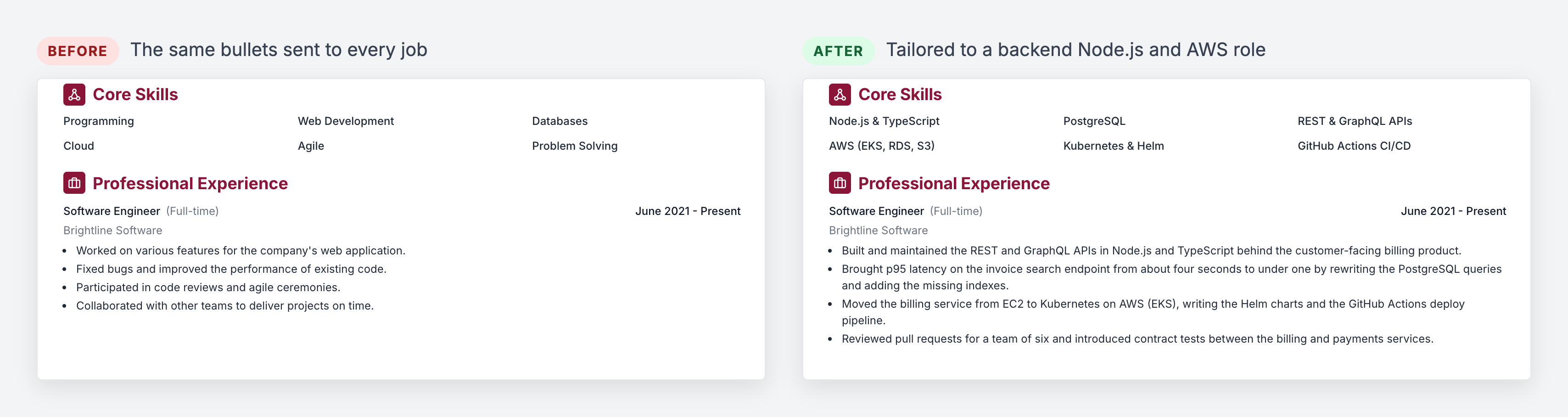
Many employers use applicant tracking systems to organize applications and support screening. These systems and the people using them can only work with the information that appears in your materials. If a job calls for stakeholder management, SQL, scheduling, account renewals, or Salesforce, and you have genuinely used those skills but describe them only in vague language, your fit may be harder to recognize.
Use the employer’s terminology when it accurately describes your experience. Do not add a long list of terms you cannot support. Keywords work best when they appear naturally in your headline, skills section, project descriptions, and accomplishment bullets alongside concrete context.
Automated screening is not a perfect measure of candidate quality. Harvard Business School and Accenture’s 2021 Hidden Workers research examined how recruitment processes and automated screening can overlook qualified applicants. In its employer survey, 88% of respondents using recruitment management systems acknowledged that hiring processes sometimes, often, or always filter out qualified high-skilled candidates who do not match exact criteria. This is not an 88% rejection rate. It is a warning that unsuccessful applications cannot always be attributed to resume quality alone.
5. The formatting makes your resume hard to read
A resume can look polished and still be difficult to scan. Dense paragraphs, tiny type, inconsistent dates, crowded columns, and decorative elements can obscure the information that matters. Complex layouts may also make text harder to extract accurately in some application systems.
Choose a simple, consistent structure. Use clear section headings, readable spacing, standard date formatting, and bullets that begin with specific action verbs. Save the version you submit in the format requested by the employer. The goal is not a flashy design; it is fast, reliable comprehension.
Proofreading matters, too. In the same 2018 CareerBuilder survey, 77% of surveyed US hiring and HR managers identified typos or grammar errors as an immediate deal-breaker. That percentage reflects respondents who named the issue as a deal-breaker, not the share of resumes rejected because of an error. Even so, checking names, dates, verb tense, punctuation, and job-specific wording is a worthwhile final step.
6. Your relevant experience is buried
Recruiters often review many applications under time pressure. If your strongest project is at the bottom of page two while unrelated early-career work fills the first page, your document may not make the right first impression.
Move the strongest evidence closer to the top. That might mean revising your summary, reordering bullets within a role, adding a selected projects section, or shortening older positions. Relevance should determine prominence, not just chronology.
For a candidate moving into data analysis, a recent dashboard project, spreadsheet automation task, or analytics course project may deserve more space than an older role with little connection to the target work. The earlier role can still remain on the resume, but it does not need to dominate it.
7. Your claims are unsupported
Phrases such as “results-driven,” “detail-oriented,” and “excellent communicator” are not inherently wrong, but they are too broad on their own. Employers need reasons to believe them.
Replace labels with evidence. Rather than saying you are a strong communicator, describe the client updates, training materials, cross-functional presentations, or written documentation you created. Rather than claiming that you are detail-oriented, show how you maintained records, caught discrepancies, coordinated complex schedules, or improved an approval process.
Specific evidence is more persuasive than a string of positive adjectives because it allows the reader to see how you worked. It also gives you stronger examples to discuss in an interview.
8. Outdated or irrelevant information is taking up space
Older tools, unrelated early experience, and details that no longer support your direction can distract from stronger qualifications. This does not mean older work has no value. Each item should earn its space by showing a transferable skill, career progression, or relevant accomplishment.
For example, someone moving into digital marketing might mention earlier customer-facing work briefly for its communication and audience insight, while giving more room to recent campaign work, analytics training, portfolio projects, or content experience. Update your skills section regularly, and remove software or certifications that no longer reflect your capability or target role.
9. You have not made the connection to the job description
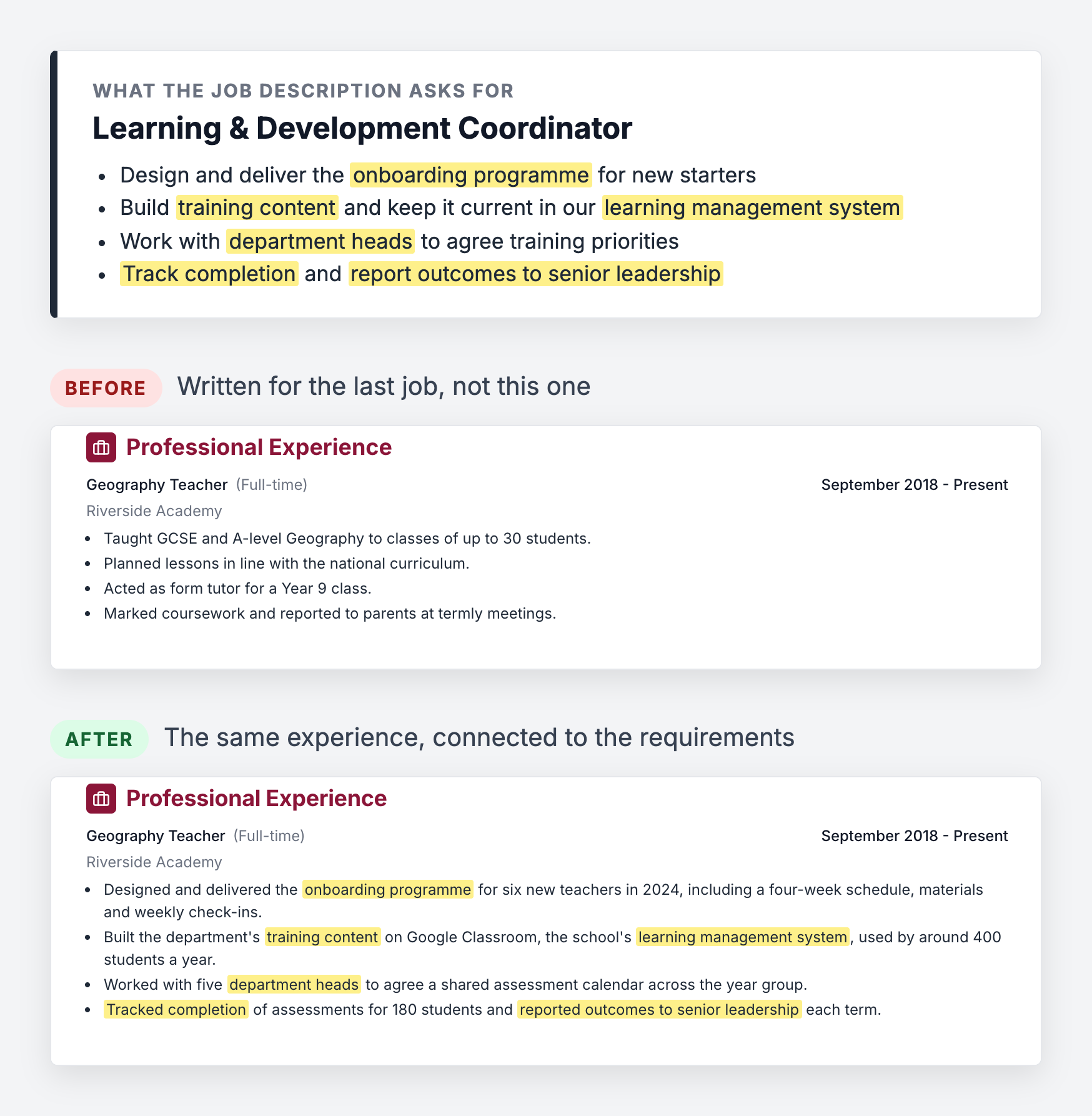
Transferable experience does not always speak for itself. A hiring manager may not immediately connect retail leadership to operations coordination, classroom instruction to learning and development, or military logistics to supply chain work. Your resume needs to make that connection without overstating your experience.
Read the job description for repeated responsibilities, required tools, and the business problems the employer appears to be hiring someone to solve. Then show comparable work from your background. If there is a genuine gap, address it through your choices: emphasize adjacent experience, relevant training, or a project that demonstrates readiness rather than implying you have done work you have not done.
10. The roles may be unsuitable or unusually competitive
Not every lack of response is a resume failure. You may be competing with candidates who have closer industry experience, a required credential, local work authorization, or a referral. The role may have attracted a large pool, been filled internally, been paused, or remained posted after the employer changed plans.
Look for patterns across your applications. If you receive interviews for adjacent roles but not a particular target, the issue may be alignment or a missing requirement. If you receive no response across well-matched applications, resume clarity and application strategy both deserve review. A balanced diagnosis prevents you from endlessly redesigning a document when the larger issue is job targeting.
Before-and-after resume examples
Software engineering
Weak: “Responsible for developing software, fixing bugs, and working with the development team.”
Why it falls short: This describes common duties but does not identify the technology, product context, ownership, or result. It gives a recruiter little basis for matching the candidate to a role.
Improved: “Built and maintained backend features for a customer-facing web application using Python and SQL; investigated production defects, documented fixes, and collaborated with product and QA teams during releases.”
The improved version does not rely on unverified numbers. It gives concrete evidence of technical work, collaboration, and operational responsibility. For a role requiring a different stack, lead with the technologies you can honestly support.
Administration
Weak: “Handled administrative duties, answered phones, and organized the office.”
Why it falls short: The wording is broad and makes the role sound interchangeable. It does not reveal the level of coordination, judgment, or systems knowledge involved.
Improved: “Coordinated calendars and meeting logistics for a busy office, maintained shared records, prepared routine correspondence, and served as a point of contact for staff, visitors, and external vendors.”
This version shows recognizable administrative capabilities. If you improved a filing process, supported a particular leadership team, or used scheduling and records systems relevant to the vacancy, add those details.
Sales
Weak: “Results-driven salesperson with excellent communication skills who exceeded expectations.”
Why it falls short: The statement makes claims without evidence. “Exceeded expectations” is unclear without a verifiable target or context.
Improved: “Managed conversations with prospective and existing customers, identified product needs, maintained account notes in the company CRM, and partnered with colleagues to address questions through the sales process.”
If documented performance information is available, add it precisely, such as a named recognition, territory scope, renewal responsibility, or verified sales result. If it is not available, specific work examples are more credible than inflated language.
What hiring research can and cannot tell you
Hiring research can be useful, but it needs careful interpretation. Surveys of recruiters, hiring managers, or job seekers reveal what a particular group reported at a particular time. Studies of recruitment systems can describe how participating employers use software. Neither proves that every recruiter follows the same process or that one resume format guarantees an interview.
When you encounter a claim about resume screening, ask who was surveyed, when the research was published, how many people participated, and whether the sample represents your industry or location. Employer practices vary by organization, role level, labor market, and stage of the hiring process. Historical survey findings should not be treated as universal facts about today’s hiring.
The practical takeaway remains useful: make your qualifications easy for both people and systems to identify. Use accurate role language, standard sections, clear formatting, and evidence connected to the work you want to do.
Resume diagnosis checklist
- Can someone quickly identify my intended role or professional direction?
- Are my most relevant qualifications, skills, and projects easy to find near the top of the resume?
- Have I shown outcomes, contributions, scope, or context rather than only listing tasks?
- Does my resume use accurate language that reflects the requirements of my target jobs?
- Is the document readable, consistently structured, and free of distracting formatting?
- Are broad claims supported by examples?
- Have I reduced outdated details and information that does not support my current direction?
- Am I applying for roles that genuinely align with my experience, training, and eligibility?
A practical process for improving your next application
- Choose one target job rather than trying to improve your resume in the abstract. Highlight the core responsibilities, required qualifications, tools, and repeated terms in the description.
- Compare those requirements with your resume. Mark where you already provide clear evidence, where evidence is present but buried, and where a real gap exists.
- Revise the headline, summary, skills, and most relevant experience first. Bring forward your strongest truthful evidence and use the employer’s language only when it accurately applies.
- Strengthen weak bullets. Add the action you took, the context or scope, and the outcome or purpose. Use verified metrics when available, but do not force numbers into every bullet.
- Check readability. Confirm that job titles, employers, dates, headings, and key skills are easy to locate. Proofread carefully and use the file type requested in the application instructions.
- Review your application strategy separately. Track the roles you apply to, their requirements, your match level, and the results. Consider whether you need a narrower target, additional portfolio evidence, networking activity, or training for a recurring qualification gap.
Use a tool such as MyResumeTool’s ATS Resume Checker as one input to your review. Treat its suggestions as prompts to verify relevance and clarity, not as a substitute for honest tailoring to a real job description.
A better resume cannot control every hiring outcome. It can make it easier for an employer to see the connection between your experience and their needs. Start with one target role, make your evidence clearer, and adjust your search based on patterns rather than a single unanswered application.
Put the advice into practice
Build a polished resume with guided editing and AI assistance from My Resume Tool.
Check Your Resume