A metric alone won’t make a resume achievement believable
Metrics show impact, but a strong resume achievement also explains how you produced the result and why it mattered. Add method, scope, timeframe, and business outcome to make numbers credible and interview-ready.
5 min read · September 16, 2026
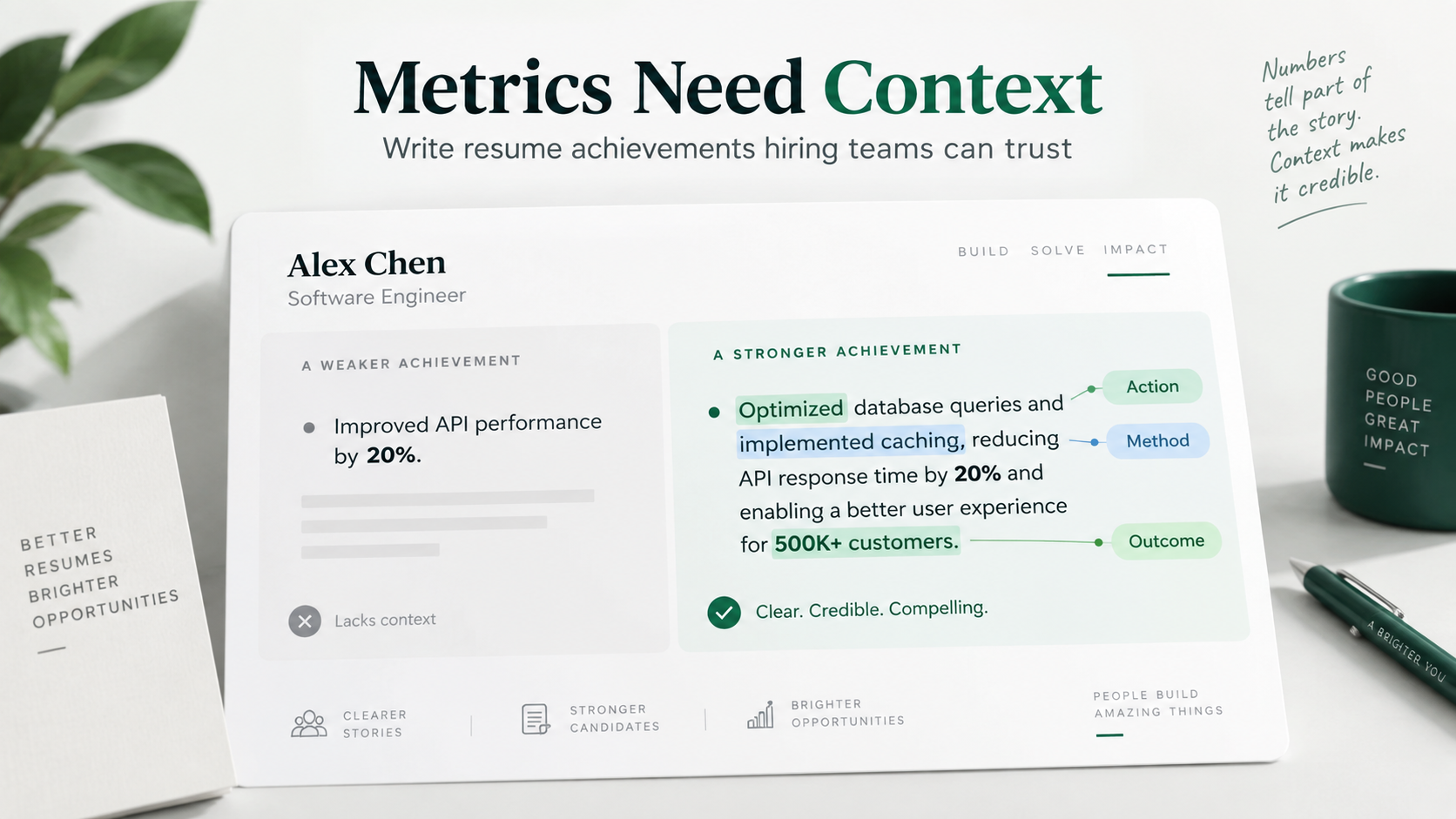
“Improved API performance by 20%.” Sounds impressive. But a bare metric does not explain how you did the work, what the improvement covered, or why it mattered. Recruiters and hiring managers want to see both the result and the reason to believe you produced it.
Why numbers without context fall flat
A number can make a resume bullet stand out, but it can also leave the reader guessing. Without context, a reviewer may not know your role in the work, how broad the result was, how long it took, or whether the result created meaningful value for the organization.
- No method means less credibility. A reviewer cannot tell whether you led the work, made a small contribution, or repeated a team-level metric.
- Unclear scope changes the meaning of the result. A 20% improvement to one endpoint is different from a 20% improvement across an entire product.
- Missing timeframe makes the work harder to evaluate. A result delivered in a week signals something different from one achieved over two years.
- No business outcome leaves the value unstated. Performance, efficiency, and engagement gains are stronger when connected to revenue, retention, cost, reliability, users, or teams.
The two questions every achievement should answer
Strengthen nearly any resume bullet by answering two questions explicitly: How did you achieve the result, and what changed because of your work?
How did you achieve it?
Name the action, decision, tool, or approach that created the change. This is the evidence behind your metric.
- If you redesigned a process, state which process you changed and what you changed.
- If you introduced a strategy, name the strategy and why it was appropriate.
- If you automated repetitive work, identify the task and the tool or script used.
- If you analyzed data, identify the data source, the problem you found, and the fix you implemented.
- If you renegotiated supplier terms, clarify what changed in the contract or pricing.
- If you restructured a campaign, explain the channel, audience, or approach you changed.
- If you improved a customer workflow, describe the user pain point and your solution.
- If you trained or reorganized a team, indicate the training, role changes, hiring decisions, or operating changes involved.
- If you introduced a system, name the type of system, such as a CRM, CI/CD workflow, or monitoring tool, and its purpose.
- If you removed a bottleneck, specify where it occurred and how you resolved it.
What changed as a result?
Then show the measurable or observable outcome. When possible, connect it to the people, process, or business area that benefited.
- For revenue growth, identify the product or business line and the mechanism, such as pricing, conversion, or upsell.
- For cost reductions, clarify the cost area, such as infrastructure, vendors, or labor.
- For faster turnaround, name the process and include the measured improvement when available.
- For retention gains, identify the program, cohort, or customer group affected.
- For error reduction, state the type of error and the operational or customer impact.
- For conversion improvement, specify the funnel, page, or stage involved.
- For time savings, quantify recurring hours saved and name the team or process.
- For productivity, define what productivity means in your context, such as throughput or tasks completed per day.
- For response-time gains, identify the system or endpoint and explain why speed mattered.
- For engagement or adoption, define the metric, such as active users or feature adoption, and state the scope.
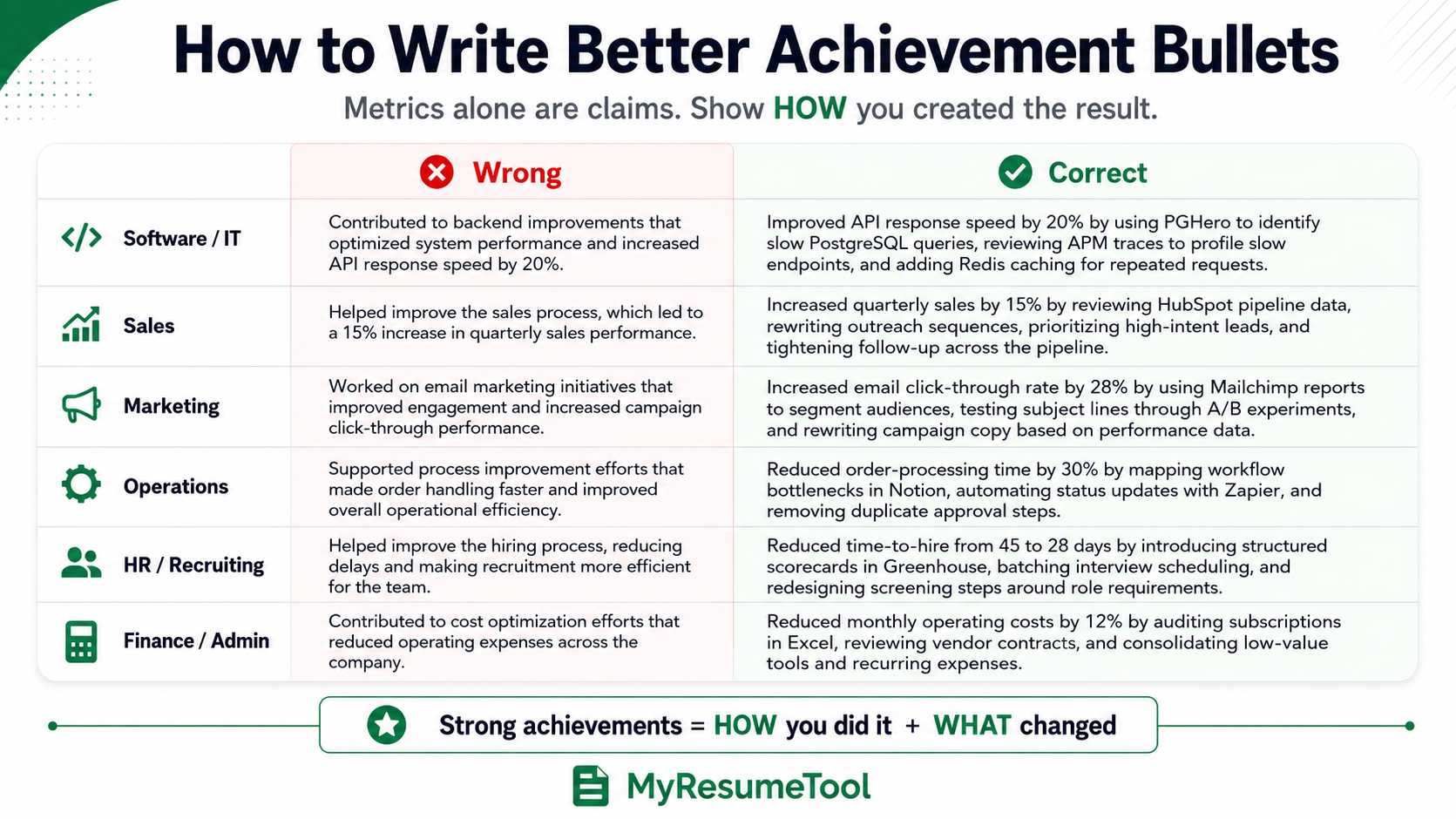
Use a structure that makes the claim easy to trust
The strongest achievements connect action to method and outcome: what you did, how you did it, what changed, and who benefited. Add a baseline, scope, or timeframe when you have one.
Action + Method/Context + Metric + Business Outcome/Scope/Timeframe
Use this structure as a drafting tool, not a rigid formula. Keep the bullet readable and prioritize the details that best prove your contribution.
- Led [activity] by [method, tool, or approach], resulting in [metric] for [scope] in [timeframe].
- [Action] [process or area] using [tool or approach], which [metric or outcome] and benefited [stakeholder].
- Automated [task] with [tool or script], saving [time or cost] for the [team or process].
- Analyzed [data source] to identify [problem], then implemented [fix], improving [metric] and reducing [negative outcome].
See the difference: metric alone versus credible achievement
A metric can remain the same while the bullet becomes much more persuasive once it explains the work behind it.
Weak: “Contributed to backend optimization efforts, improving API request speed by 20%.”
Stronger: “Reduced recurring memory exhaustion and system crashes by restructuring parts of the backend architecture and using PGHero to identify and optimize expensive database queries—improving API response speed by 20%.”
Both bullets claim the same end result. The stronger version identifies the problem, the actions taken, and the approach used. That context makes the claim more believable and gives an interviewer specific areas to explore.
Show method and impact even when you do not have a number
Not every worthwhile contribution comes with a hard metric. Do not invent one. Instead, make the before-and-after change, your method, and the affected stakeholders clear.
Weak: “Improved onboarding.”
Stronger: “Redesigned the first-week onboarding flow by consolidating setup steps and adding in-app guidance, lowering drop-off during activation and improving new-user satisfaction.”
Weak: “Cut costs.”
Stronger: “Negotiated vendor contracts and implemented monthly usage reviews, reducing recurring licensing costs and preventing over-provisioning across our cloud environment.”
- Use clear qualitative outcomes, such as improved satisfaction, reduced friction, or fewer incidents, and explain the scope and method.
- Use an approximate range only when you can support it, such as “saved ~10–20 hours/month,” and be prepared to explain the estimate in an interview.
- Describe the situation before your work and what changed afterward.
- Reference the teams, customers, or processes affected by the change.
- If possible, collect a simple baseline measurement before leaving a role. Even one baseline can make a later claim stronger.
Check every achievement before you submit your resume
- Have I named the action I took, such as led, automated, redesigned, analyzed, or negotiated?
- Have I described the method, tool, or decision that produced the change?
- Have I included a metric or a clear outcome, plus useful scope or timeframe?
- Have I tied the result to a business, operational, or user benefit?
- Can I explain and defend this bullet in an interview with specific details?
Metrics make resume bullets pop. Context makes them credible. Combine a clear action, the method you used, and the measurable or observable outcome that followed to create achievements hiring teams can trust—and focused interview questions you can answer with confidence.
Put the advice into practice
Build a polished resume with guided editing and AI assistance from My Resume Tool.